
In the golden light of a crisp New England morning last fall, a 1923 L.C. Smith No. 8 typewriter waited to be rediscovered, tucked away on the second floor of an antique store just off 495 in Lawrence. I had a birthday approaching, and a Zoom background to build for a remote job I had started that April. A relic of the past, I had chosen a typewriter because they brim with the allure of stories yet to be told, words unsaid, and histories long-forgotten.
It was the perfect Zoom background for a writer even if it didn’t type. I didn’t care if it ever typed. I just opened the casting call for a typewriter, and picked the first one that fit the bill–no experience with typewriter repair and no research.
I brought it home and set it on a table.
The typewriter was rusty and covered in a half-inch of dust, its keys locked in a stubborn silence.

‘Hey, why don’t I fix it up?’ I thought.
So I did.
The Typewriter’s Connection to New England, Lowell, and Jack Kerouac
New England, a region well known for its literary history, boasts a unique, enduring relationship with the typewriter. H.P. Lovecraft and Robert Frost, giants among New England’s literary landscape, often composed their iconic works on these mechanical marvels.
So did Lowell’s own Jack Kerouac (1922-1969), an author and poet from the city’s Centralville neighborhood who grew up to become a significant figure in the Beat Generation, a mid-century literary movement known for rejecting standard narrative values, exploring American culture and politics, and embracing Eastern spirituality.
Kerouac’s best-known work, “On the Road,” was influential in defining Beat culture and his spontaneous and stream-of-consciousness writing style left a lasting impact on the literary world.
So, here’s the typewriter connection: It’s hard to type stream-of-consciousness when you’re pausing every 250 words to load a fresh sheet of paper into a typewriter.
Kerouac’s most enduring story, related to typewriters, comes when he invented his “scroll” method, where he built a continuous roll of tracing paper sheets by cutting them to size and taping them together. When he loaded the “scroll” into his Underwood typewriter, he could type without stopping.
Maybe, he would have loved the endless white scroll of a new document in today’s Microsoft Word.
Amid the 21st century’s digital clatter of social media, 24-hour newsfeeds, and paperless books, a community of people still clamor for the echoes of the typewriter–to collect them, write on them, restore them, or even just display them, at weddings, in offices, in Zoom backgrounds, even typewriter chat groups.
Each typewriter, from the sturdy, stoic Royal KMM to the nimble Remington 5 Streamline, represents a chapter in writing history, waiting to be read, understood, and appreciated. Beyond writing, typewriters embody the story of writers and their craft. They’re very much an enduring staple of 20th-century America.
The Art of Restoring Vintage Typewriters
Restoring a vintage typewriter is much like running a local history blog. You’re preserving history, uncovering its story, and restoring a voice long since silenced by time.

The L.C. Smith No. 8 now in my home office, for instance, presented its own unique challenges. The carriage wouldn’t move, the keys were rusted in place, and the entire machine was coated in a half-inch of sticky brown dust. I guessed it had sat, uncovered, in someone’s garage for thirty, maybe forty years.
I started my first typewriter restoration project by gently disassembling each piece, studying how the springs and levers fit together, how the keys drove the type-bars, and pondered how this 40 lb. century-old artifact once translated human thought into printed words.
I wondered if that L.C. Smith would ever type again.
Something deeply gratifying surges within you when you can breathe life back into a discarded typewriter, witnessing the type-bars spring back into action for the first time in decades, hearing the bell’s cheerful ding come alive at the end of a line, and seeing the once faded letters now striking sharply against a fresh ribbon.
Its restoration spanned months and included extensive cleaning and strategic oiling, a new drawband, the freeing of a jammed ribbon key, and reworking the shift mechanism. Some parts, like the ink ribbon, I could source easily online. Others, like tab stops, I found through connecting with other typewriter enthusiasts through Facebook groups.
But typewriter restoration isn’t just about the mechanics. Each typewriter carries its own ambiance and unique energy, which inspires writing, if you’re open to listening to it. As I polished the L.C. Smith’s ebony finish, I thought of the countless hands that had touched these keys before me.
During the restoration, the typewriter gave up its secrets, one by one. With its serial number, I discovered that it had been manufactured in 1923, two years before the merger of the L.C. Smith and Corona companies. Its post-1925 L.C. Smith and Corona decal on the front told me that the machine had been refurbished at some point in its history. Someone with the initials CT had carved into the back of its paper tray in October 1933.
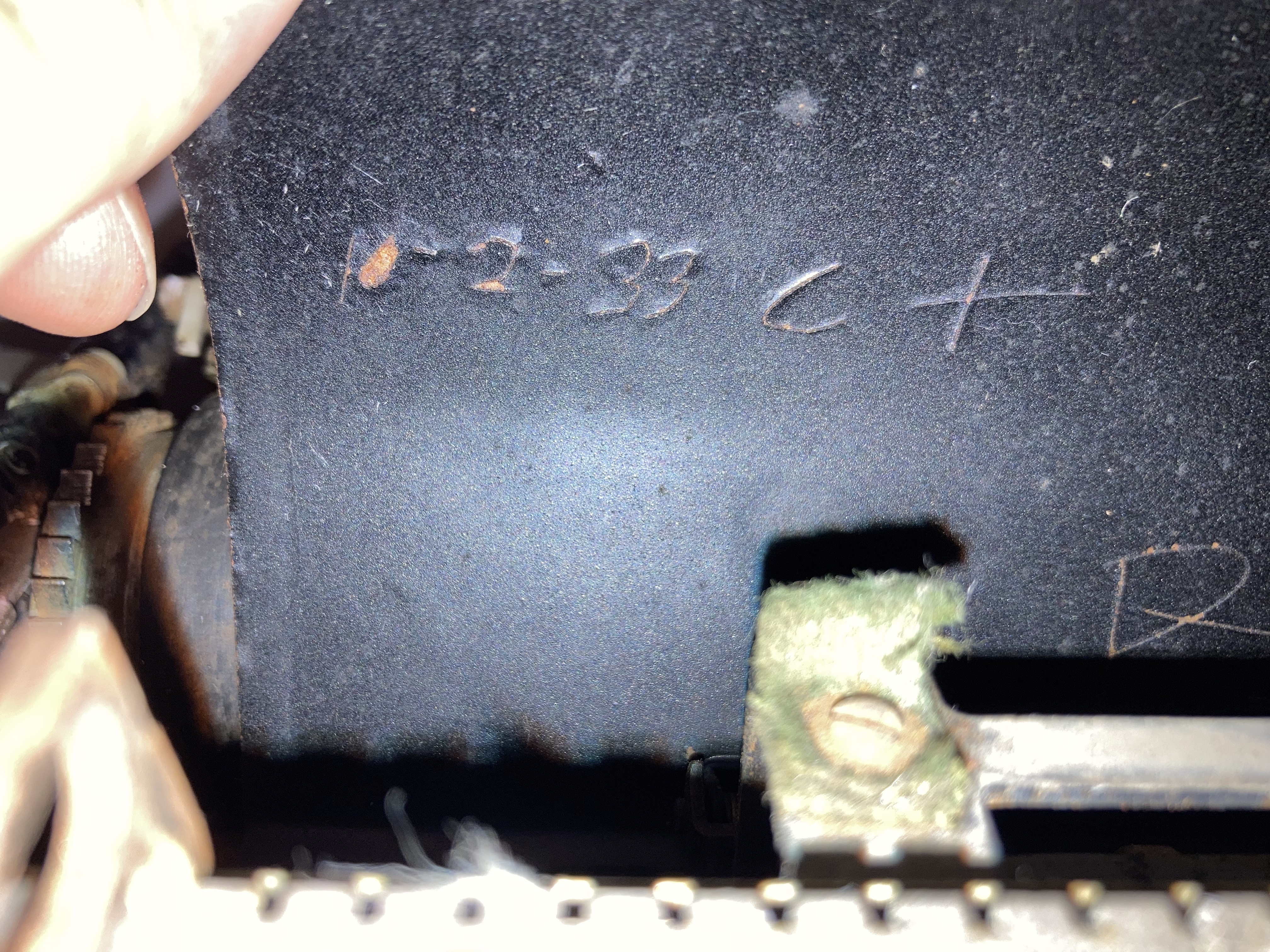
By 1947, Active Typewriter Service of Brooklyn, New York owned the typewriter and probably lent it out to New York City-based companies that needed a replacement for a broken machine or to resource a temp worker. How that typewriter made the 220-mile trip north to Massachusetts in 85 years since remains a mystery.
Whenever I sit down to type on the typewriter, I wonder who has sat in front of it before me. Perhaps a young woman typing an accounts payable letter on her first day on a job in a New York City insurance company office. Perhaps an aspiring author, pouring their dreams onto paper, one keystroke at a time. The L.C. Smith typewriter, a silent observer to these lost moments, becomes a vessel of shared human experience. In restoring it, we honor this shared history, ensuring that these echoes of the past continue to resonate into our present.
The Allure of Typing on a Vintage Typewriter
Typing on a vintage typewriter, especially one you’ve painstakingly restored, is an experience unlike any other. In an era where digital interfaces dominate, there’s something incredibly grounding about the physicality of a typewriter.
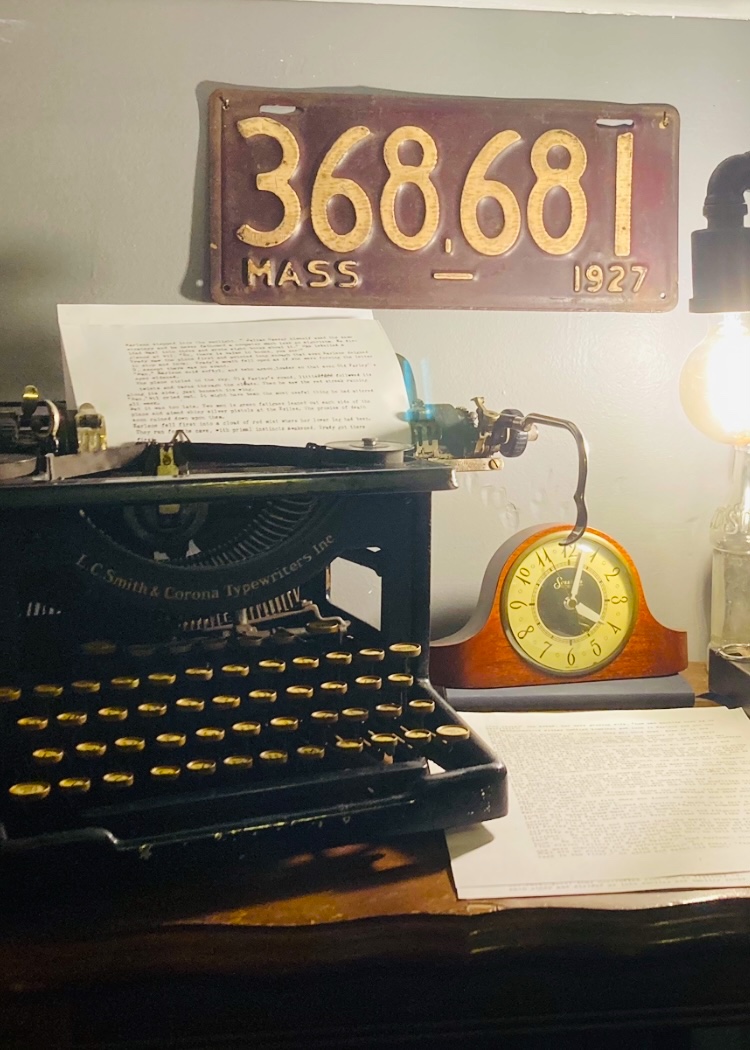
Each stroke of a key is a commitment, each word a physical entity. It recalls a time when writing was a deliberate act, not just a flurry of thoughts captured on a screen. Words are said, and cannot be unsaid. Even with the best correction fluid, the imprint of our words remain even when we try to erase and overwrite them. The clatter of the keys, the mechanical rhythm of the type-bars, and the satisfying imprint of fresh ink on paper, all contribute to a rhythm that becomes almost meditative.
There’s an immediacy that a typewriter brings to writing, a charm that makes each typed page a work of art in its own right. Whether it’s a letter, a draft of a novel, or simply a page of fleeting thoughts that form some kind of journal, a typewriter brings a character to your words that is hard to replicate on a digital device.
Conclusion: Preserving Stories, One Typewriter at a Time
Restoring vintage typewriters is more than a hobby – it’s a journey through time, a tribute to the forgotten era of mechanical ingenuity, and a preservation of tangible history. It’s an opportunity to connect with the stories that have shaped our world, a reminder of the craftsmanship of yesteryears, and a celebration of the joy, and work, of writing.
For those of us in New England, every vintage typewriter restored is a piece of our literary heritage reclaimed, a nod to the authors who’ve left their mark on the region, and a salute to the ones who continue to do so.
In a world that’s rushing towards the future, these typewriters invite us to pause, remember, and appreciate the beauty of words crafted one key at a time. They encourage us to listen to the echoes of the past and carry those echoes forward into our own narratives.
And so, as I type new drafts on the L.C. Smith No. 8 that I found, forgotten and non-working, in that Lawrence antique store, I am not just telling stories; I am channeling the heritage of writing into my own work, and harnessing the tools of creativity from a fading age.
If you have your own typewriter tales or treasures that you’ve found hidden in the antique stores and attics of New England or beyond, feel free to share your stories in the comments. If you’re thinking about starting your own restoration journey, don’t hesitate to reach out for a tip or two. After all, every key we unstick, every bell we chime, adds another note to the symphony of our shared history.
 Forgotten New England
I typed many a paper in the late 70s graduating from college in 1981. After college I took a BASIC class at University of Lowell (then) and kept using the letter l for one. Needless to say that did not work out well. Kids today would never have that problem!
Keep up the good work Ryan!
A lot of people think this typewriter is broken because it doesn’t have a “1” key.
Last year, I went about acquiring and restoring several typewriters. Three Underwoods, a Royal, and my grandfather’s 1923 Remington Compact are now sitting in various parts of my home. As a youngster I was told never to touch my grandfather’s typewriter. So I would sit near him to watch the keys bounce off the platen and listen to the mechanical aspects of the typewriter itself. 50 years later, it sits inside a glass cabinet, but under my guard now.
My Royal KMM once belonged to a lawyer in the Baltimore area. It’s in really nice condition for a 75-year-old typewriter so I think it has a similar story.
Royal & Underwood Typewriter Companies were headquartered in Hartford, CT. At its height in1947, Royal was the centerpiece of Hartford’s leading role in the global production of typewriters, along with the competing Underwood Typewriter Company. Royal left it’s large complex in Hartford in 1972, at which time my neighbor, a pattern maker at Royal, was sent to England for a couple of years to train his replacement. The complex was listed on the National Register of Historic Places on 12 Feb. 1989. Sadly, 2/3 of the complex was destroyed by fire in 1992, after which, the remainder was torn down, replaced by a Super Stop & Shop.